wd06: Derek Featherstone - Accessibility 2.0

  • 2006-09-28

[Semi-liveblogged]

Real subtitle should be 'Where do we go for beer?'

Checklist syndrome: bringing down accessibility
Leads to a compliance/QA impersonal approach

But accessibility is personal, it’s about user testing and it’s about removing barriers.

“What if screen readers could access microformats? How cool would that be?”

Where should we be looking for inspiration for web accessibility?

  • How about the gaming industry? Gamers have some crazy keyboards and input devices.
  • The physical world - eg. pedestrian crossing buttons which vibrate as well as click/beep. "How cool is that?" Or the braille/raised lettering sign that put the tactile signage on a comfortable angle for ease of use. It doesn't just comply, it creates a good user experience.
  • How about the car industry? They solve all kinds of issues, maybe they've got ideas we should be taking on board.

Discussed the accessibility features being created for Blackberries. Also admitted he sleeps with his Blackberry; said he wouldn't tell us where on Flickr you can find the image, but "hey with tagging no doubt you'll be able to find it...". Well, yup: http://www.flickr.com/photos/glsims99/14020019/

Cognitive disabilities: people don't seem to know what to do, although some companies are starting to work on it. Some new phones are being built with simple interfaces; consistent toolbars and uncluttered menus. The obvious thing to note here is that making things consistent and easy to use helps everybody, not just people who would identify themselves as "disabled".

Let's make things easier for everyone. Thing about tagging - "these are the same people I tag on Web Connections, d.construct, Flickr, Cork'd... we all tag each other, that's all we do now!!!"

What if we let users define their own access keys so authors don't have to do it? Not to mention they interfere with people's existing key profiles. Why not create a microformat which stores this information? Think of the power of that. What if we get to a point where we don't supply any CSS any more? Users set up their global stylesheet and have their preferred styles applied to everything! "...the power! POWER TO THE PEOPLE! That's what this is about."

What if the browser could learn? It could recognise that the last three times you visited a site you bumped up the text size, then just do that for you.

What if we replaced all the browser controls with a button that says "I can't read this page", which launches a wizard to help you change it so you can read it.

Q&A

How to convince people that it's important?

One thing - show people assistive technology users. "It's a life changing experience. I don't know anyone who didn't find it a life-changing experience to see a screen reader user or a mobility impaired user with speech recognition software."
wd06: John Allsopp - Microformats

  • Thursday, September 28, 2006

[Semi liveblogged - patchy network today]

How do we get information?

Example: trying to find out what movie is good to go see.

  • Who do we trust to review a movie?
  • Can we trust centralised systems like IMDb?
  • Who owns the reviews?
  • Can we verify that the reviews are real?
  • Can we verify that they haven’t been modified since the author created them?

We want to tap into the wisdom of many people.

  • Try google? No, too many results and no reviews in the first few pages anyway.
  • Try aggregators? Blog searches? Not really working.

So we could write a review search engine, but how to identify a review? How do you get a consistent review scale?

People are really good at getting information from a surrounding context, but software is really bad at it.

Do we wait for the W3C to deliver all this and more with XHTML2? Do we invent new XML languages?

Microformats can provide this structure and allow search tools to access and index the info.

Microformats:

  1. simple
  2. html based
  3. data formats
  4. based on existing standards
  5. based on current developer practice

...their purpose is to bring richer semantics to today’s web:

  1. it doesn’t break browsers
  2. it doesn’t break pages

“Great technology needs to be adopted. But it’s chicken and egg. So we do have a chicken – no, wait, which one does come first?”

They are in use – technorati is a really big, well-known user of microformats but there are many more out there.

Get the Tails extension for Firefox and check out the web directions sites.

John finished with an example of using hCard, to show how easy it is.

“I’m always really scared when I type URLs in directly on screen… I’m not sure what you’ll see in my history!” – JA

“Sure I’m a geek but that’s COOL

What are you waiting for? They’re out there, get involved. Use them!

John just won “first person to pimp their book”…

Q: What’s the process for getting from idea to microformat?

There’s a detailed process on the microformats wiki; it starts with logical questions like making sure there’s a problem to be solved.

wd06: the hot toy

  • Thursday, September 28, 2006

The coolest toys I've seen this year so far: tablet pc. I really wish I had the cash for one of those!

Certain readers might be amused to know that I'm getting along with the Macbook better than last time I tried to use it :) Mostly because an open network has been installed, getting around the requirement for a VPN client (none of which seem to work yet on the intel macs). Not saying I'm ready to switch, but it hasn't been especially painful this time.

wd06: Jeremy Keith - is AJAX hot or not?

  • Thursday, September 28, 2006

[Liveblog - liveblogging may continue depending on batteries and wrists ;)]

Jeremy Keith is running through 'am I AJAX or not'. Good points about the definition of AJAX - it's such an abused term; people tend to equate it directly with 'Web 2.0' (another abused term!).

I guess ultimately from the point of view of the user, they simply don't care. It's not about whether something is AJAX or not, so much as 'does it work'; and AJAX techniques (used for good and not evil) can create that sensation. Users can get small bits of information back quickly without waiting - people like the feeling of speed and the page hasn't triggered boredom responses.

Jeremy goes on to suggest that the way to choose when to use AJAX is to get into pattern recognition - what user behaviour and expectation will benefit from AJAX? For example adding a product to an online shopping cart - the user doesn't want the whole page to go away and reload just because they added something to the cart. When you don't need to update the entire page, then it's a good time to use AJAX.

But, a bad time to use AJAX might be to have entire pages of search results - you're keeping less than you're changing. Traditional paradigms hold true and the user's experience isn't disrupted.

A great way to illustrate the principle of 'keep the user informed': Jeremy (like me, as it happens) likes the window seat on planes so he knows when the plane is about to actually land. The moment of impact is scary if you can't prepare, but really not too bad when you know it's about to happen.

Jeremy echoes somehing that Derek discussed yesterday in the Accessibility 2.0 workshop: if you emulate an interface feature, you must emulate it completely. Which is a great argument to support being a bit more choosey about when to use certain UI features. Do you really need to have drag and drop in a web app? Will your users expect it? Have you emulated every possible outcome of the drag/drop motion? You need to be aware of all the implications of what you're doing.

A big reminder: if it's not accessible, it's still no good! Things must still be accessible and usable. You don't get to dodge the accessibility requirements just because AJAX is 'new and shiny'. The good news is that AJAX does not preclude accessibility, but you have to be really aware of what you're doing and what will happen in screen readers.

In closing, Jeremy once again quoted Tim Berners-Lee: The power of the web is in its universality... In my opinion, I don't care if it is cliched to use that quote. For me it never gets old. It is and will remain an incredibly important statement about what the web should be.

I think it's a great thing for our industry that a talk on AJAX finished with a discussion of accessibility.

web directions south 2006 - kelly goto keynote

  • Thursday, September 28, 2006

WD06 just kicked off with a keynote from Kelly Goto. This session really sums up the reason I was so excited to be coming (let alone speaking here!). If you rocked up to this conference with no intro, you'd be caught by surprise - it was not head-buried-in-the-code. It was about humans and the way we interact with machines.

Discussing deep hanging out; discussing how you should try to create ritual and not addiction. It's a perfect way to sum up the successful nature of systems like Flickr, journals, etc. If something is usable, fun and it can be easily integrated into your life; then it's a winner.

This conference is not the average. If you're here, awesome. If you're not here, get ready to download the podcasts.

directions and connections

  • 2006-09-22

So it's just a few short sleeps to Web Directions 2006. Or, as it's been called for a few days now, Web Directions South. That'd be the green one. The orange one will be announced on Monday :)

After Web Essentials 2005 many of us did wonder what the organisers could come up with in 2006 - WE05 was a hard act to follow. So far we have Tshirts and a microformat- and API-driven networking system. Web 2.0 is nothing more than a slogan to many people; but WD06 is living the dream ;)

So if you're heading to WD06, get over to Web Connections and sign up. Sure, you'll probably get tagged by weirdos, but that's all part of the fun!

On a quick personal note; you may notice my Web Connections profile lists my new employer: News Interactive. I didn't mention it in the previous post since I felt like it was a little silly to talk about it before I was actually here. So, there you have it :)

the joy of bandwidth theft

  • 2006-09-02

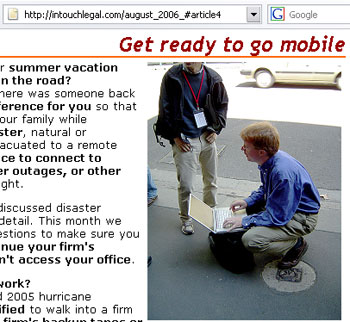
Hotlinking (aka bandwidth theft) is generally more annoying than amusing. But this time I had to chuckle: bandwidth theft and copyright breach by a company with ties to the legal industry (InTouch Legal). Good thing they help the lawyers, I'd be worried if they were lawyers.

Screenshot of photo being used without authorisation

You know, I'm pretty sure Eric is ready to go mobile. [View the original post if you're curious.]

The mission statement is definitely amusing: The Mission of InTouch Legal is to provide outstanding technology and management solutions to the legal community while developing extraordinary client relationships through integrity and accountability. Integrity and accountability, eh?

So what do you do when you find that someone is piping your image out on their newsletter? The temptations are endless, but in the end I've opted for simplicity.

Screenshot of photo replaced with copyright notice

I think prospective clients of InTouch can make up their own minds about their integrity and accountability.

Blog Archive